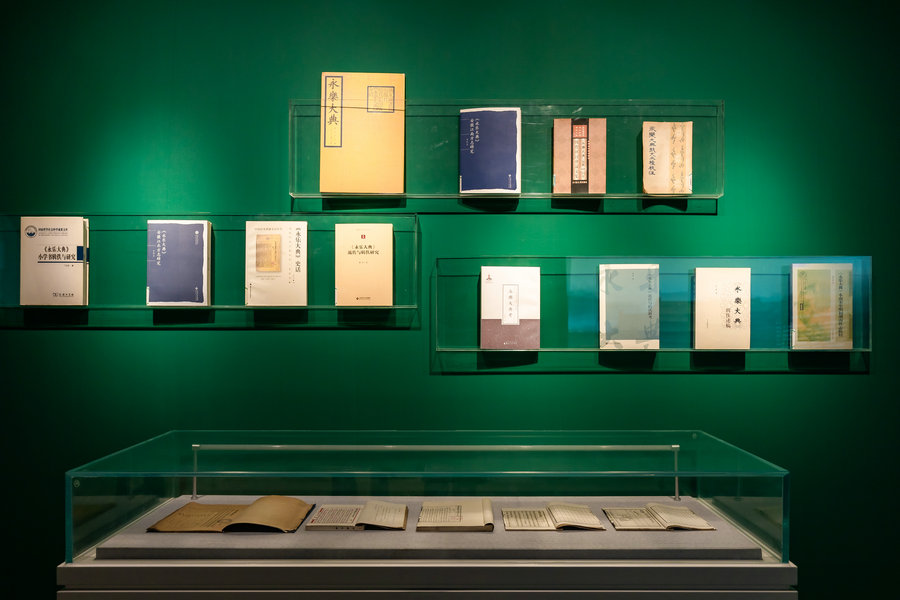
Yongle Encyclopedia
Introduction
The Yongle Encyclopedia, also known as the Yongle Dadian, stands as one of the most ambitious projects in the history of Chinese literature. Commissioned by the Yongle Emperor of the Ming Dynasty in 1403, this monumental work was a massive compilation endeavor intended to encompass all existing knowledge of its time. Completed by 1408, the encyclopedia included a wide array of subjects—spanning from astronomy to geography, religion, and arts—reflecting a comprehensive repository of knowledge and cultural heritage.
This encyclopedic work comprised 22,937 volumes in 11,095 copies, containing an estimated 370 million Chinese characters. The encyclopedia's sheer scale and the breadth of topics it covered made it the largest paper-based encyclopedia ever compiled. The Yongle Encyclopedia was not just a collection of summarized introductions but a leishu, or "category book," featuring expansive citations and entire works categorized by themes and pronunciations of keywords.
Despite its historical significance and the immense effort put into its creation, the original edition of the Yongle Encyclopedia has been lost to time, with only about 400 volumes of a duplicated edition surviving today. These surviving volumes are cherished as invaluable cultural artifacts, embodying the intellectual spirit and aspirations of the Ming Dynasty.
Historical Background
The Yongle Encyclopedia was conceived during the Ming Dynasty, a period characterized by significant cultural and intellectual development. The Yongle Emperor, born Zhu Di, assumed the throne after a civil war and sought to legitimize his rule not only through military might but also by fostering cultural and intellectual advancements. In 1403, he commissioned the creation of the encyclopedia as a testament to the scholarly achievements and cultural wealth of China.
The Ming Dynasty, which lasted from 1368 to 1644, was a time of consolidation and expansion for China. The Yongle Emperor's reign (1402-1424) was particularly notable for its ambitious projects, including the construction of the Forbidden City and the commissioning of the Yongle Encyclopedia. This period saw a flourishing of arts, literature, and scholarship, with the encyclopedia symbolizing the zenith of Ming intellectual endeavors.
The Yongle Encyclopedia was an embodiment of the emperor's vision to collect, preserve, and disseminate knowledge. By compiling all known scholarly works, the encyclopedia served as a reference for culture and learning, reflecting the emperor's desire to rule with a focus on culture and intellect.
Compilation Process
Initiation and Planning
The initiation and planning of the Yongle Encyclopedia were driven by the Yongle Emperor's ambitious vision. In 1403, shortly after securing his rule, the emperor appointed Xie Jin, the chief of the cabinet, to lead the project. Xie assembled a team of about 100 scholars to begin drafting the encyclopedia. However, the initial draft did not meet the emperor's expectations, as it focused predominantly on ancient classics without encompassing the broader spectrum of knowledge.
Recognizing the need for a more inclusive work, the emperor appointed Yao Guangxiao, a monk and political advisor, as the new editor-in-chief. Under Yao's guidance, the project expanded significantly, eventually involving over 2,000 scholars. The team referenced an impressive 7,000 kinds of books, covering a vast array of subjects, to compile this comprehensive work.
Organization and Execution
The organizational and executional aspects of the Yongle Encyclopedia were monumental in scale. Without modern cataloging systems, the scholars relied on meticulous organization and categorization to manage the vast amount of information. The compilation process involved extensive research, sourcing original texts, and ensuring accurate citations for inclusion in the encyclopedia.
The scholars adopted a systematic approach, beginning with individual words and expanding on related subjects. This method allowed for the inclusion of detailed illustrations, human portraits, and a variety of topics such as architecture, geography, agriculture, and antiques. The encyclopedia was remarkable for its word-for-word records of original documents, ensuring the preservation of key historical files.
The execution of this project required immense resources and national-level coordination. The government provided the necessary materials and support to sustain the scholars' endeavors, reflecting the importance placed on this literary undertaking.
Content and Structure
Topics and Subjects Covered
The Yongle Encyclopedia encompassed an extensive range of topics, illustrating the breadth and depth of Chinese knowledge during the Ming Dynasty. The subjects covered included the Confucian classics, poetry, history, astrology, geography, medicine, and various other fields of study. This comprehensive approach aimed to create an anthology of knowledge, offering a window into the intellectual landscape of the time.
The encyclopedia's format as a leishu allowed for the inclusion of lengthy citations and entire works, rather than just excerpts. This structure provided a detailed representation of the subjects, making it a valuable reference for scholars and readers alike. The inclusion of numerous illustrations further enriched the encyclopedia, offering visual insights into diverse areas of study.
Classification and Arrangement
The classification and arrangement of the Yongle Encyclopedia were key to its utility as a reference work. The encyclopedia was organized based on themes and the pronunciation of key words, a method that facilitated easy navigation and access to specific topics. This thematic categorization distinguished the Yongle Encyclopedia from modern encyclopedias, which typically offer summarized introductions.
The encyclopedia's structure was meticulously designed to ensure the preservation and accessibility of knowledge. The careful arrangement of subjects allowed readers to explore related topics seamlessly, making it an invaluable resource for scholars and intellectuals of the time.
Significance and Legacy
Influence on Later Works
The Yongle Encyclopedia had a profound influence on subsequent scholarly works and compilations. Its ambitious scope and comprehensive nature set a benchmark for future reference works, inspiring the creation of similar encyclopedic projects in China and beyond. The encyclopedia's format, which included lengthy citations and entire texts, influenced the development of leishu compilations and contributed to the preservation of ancient knowledge.
The encyclopedia also served as a source of inspiration for later cultural and intellectual pursuits. Its preservation of ancient texts provided subsequent generations with access to valuable historical documents that might have otherwise been lost. The Yongle Encyclopedia's impact extended beyond its immediate context, shaping the intellectual landscape and serving as a testament to the enduring value of knowledge preservation.
Cultural and Educational Impact
Culturally, the Yongle Encyclopedia represented the apex of Ming Dynasty scholarship and the emperor's commitment to fostering intellectual growth. It embodied the humanistic spirit and moral norms of its time, offering insights into the cultural and philosophical underpinnings of Chinese society. The encyclopedia's emphasis on comprehensive knowledge aligned with the Confucian ideals of learning and the pursuit of wisdom.
Educationally, the Yongle Encyclopedia served as an invaluable resource for scholars and educators. Its extensive coverage of diverse subjects provided a foundation for learning and research, contributing to the dissemination of knowledge across generations. The encyclopedia's preservation efforts ensured that key historical texts and scholarly works were accessible to future scholars, fortifying the intellectual heritage of China.
Preservation and Rediscovery
Loss and Recovery Efforts
Tragically, the original edition of the Yongle Encyclopedia was lost over time, and its exact fate remains a mystery. Political upheavals, fires, and invasions throughout history contributed to its disappearance. However, a duplicated edition created during the reign of Emperor Jiajing in the 16th century managed to survive, albeit with significant losses over the centuries.
Efforts to recover and preserve the surviving volumes have been ongoing. Historical records indicate that fewer than 400 copies remain, housed in various institutions and private collections worldwide. Diligent efforts by scholars, collectors, and institutions have been made to locate, acquire, and preserve these invaluable volumes to ensure their continued existence.
Current Locations of Surviving Copies
Currently, the surviving copies of the Yongle Encyclopedia are dispersed across approximately 30 public institutions and private collections in seven countries. The largest collection is housed at the National Library of China, which possesses 224 copies, including some temporarily stored at the National Palace Museum in Taipei.
Other notable collections are held by libraries and museums in the United Kingdom, Germany, the United States, Japan, and Ireland. These institutions have played a crucial role in preserving the surviving volumes and facilitating research and access to this monumental work.
Efforts to digitize the surviving volumes have been undertaken to enhance accessibility and preservation. Digitized versions have been published, allowing scholars and the public to engage with the encyclopedia's content and explore its historical and cultural significance.








